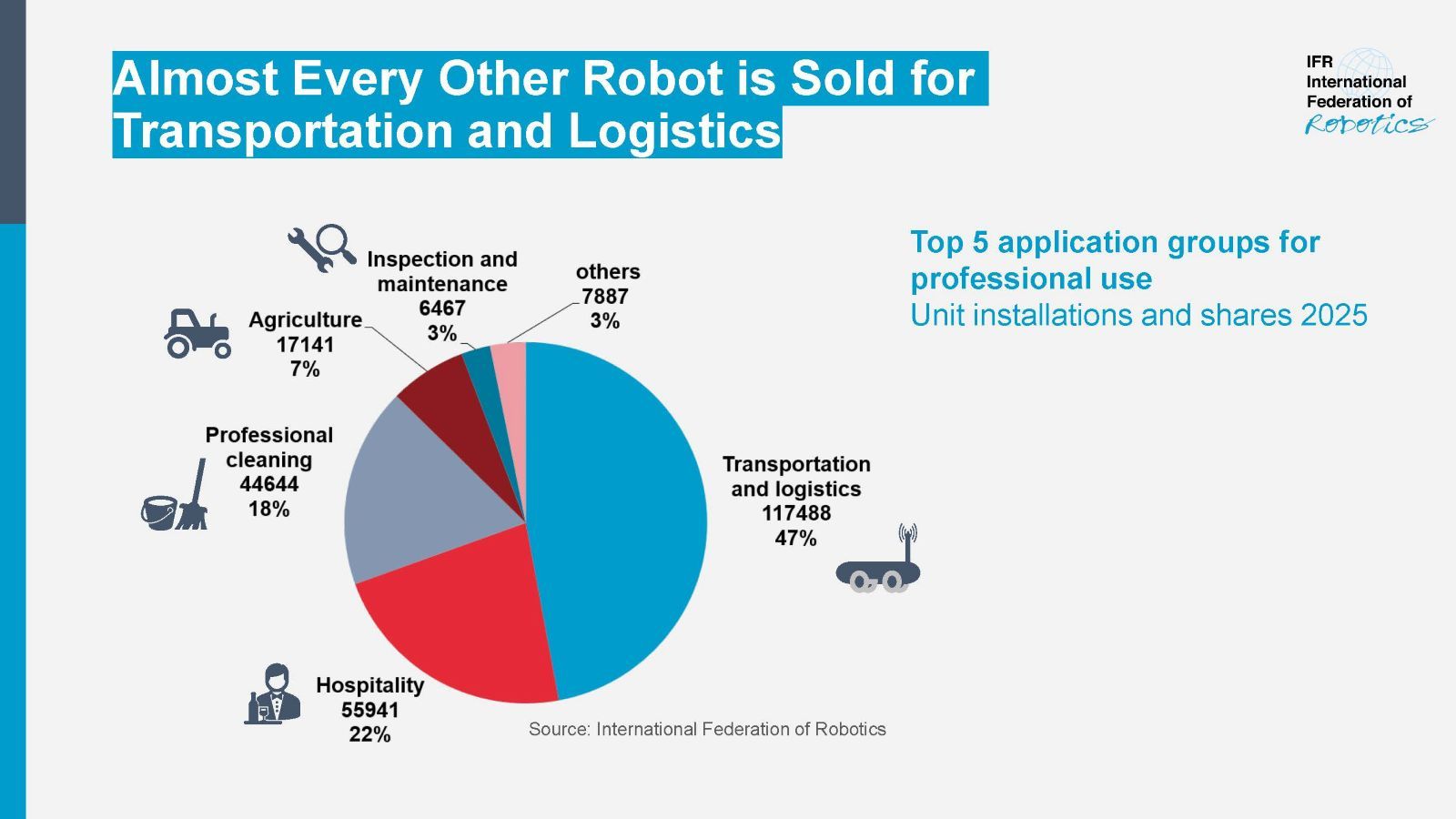
Short answer: Warehouse robots fall into five families: AGVs on fixed routes, AMRs that plan their own paths, goods-to-person robots, AS/RS and conveyor or sortation lines. Pick by flow, not by brand. ISO 3691-4:2023 is the core safety standard for AGVs and AMRs, and the EU Machinery Regulation adds autonomous-machinery rules from 20 January 2027. Transport and logistics robots sold 117,488 units in 2025 (IFR).
Applies to: EU, UK, US, GCC (Saudi Arabia) and India. Last reviewed: 12 Nov 2026. This hub is updated as new guides in the pillar go live. Asset Online Pvt Ltd (AOPL) supplies and integrates solutions in this area.
This post covers what warehouse robots are, a decision map across the five families, the market numbers, the safety standards, the rules in each region, fleet planning, cost drivers and every AOPL guide in this pillar.
Key takeaways
- Transport and logistics robots sold 117,488 units in 2025, up 21%, which is 47% of all professional service robots (IFR, World Robotics 2026 Service Robots, 30 Sep 2026).
- ISO 3691-4:2023 names "autonomous mobile robot" and "automated guided vehicle" as examples in its scope. It excludes trucks guided only by rails and doesn't cover the extra hazards of trucks meant for public zones (ISO 3691-4:2023, Clause 1).
- Regulation (EU) 2023/1230 applies from 20 January 2027 and requires autonomous mobile machinery to have a supervisory function, plus guarding or person detection (Article 54; Annex III, 3.2.4 and 3.3.3).
- ANSI/A3 R15.08-3, which A3 announced as available in late September 2026, puts risk assessment, management of change and training on the site that runs the robots (A3 announcement, reported by Automation World, 30 Sep 2026).
What are warehouse robots, and which types are there?
Warehouse robots are machines that move, store, pick or sort goods with little or no human driving. Most buyers use the term for five families.
- AGV (automated guided vehicle). A driverless vehicle that follows a defined route marked by tape, wire, QR codes or reflectors. It stops when the path is blocked.
- AMR (autonomous mobile robot). A driverless vehicle that maps the site, plans its own route and drives around people and obstacles.
- Goods-to-person robots. Mobile robots that lift a shelf, rack or tote and bring it to a fixed picking station, so the picker doesn't walk.
- AS/RS (automated storage and retrieval system). Cranes, shuttles or grid robots that store and fetch loads inside a dense rack structure.
- Conveyors and sortation. Fixed belts, rollers and sorters that move high, steady volumes along a set line.
The safety standard draws the line between the first three and the last two. ISO 3691-4:2023 covers driverless industrial trucks and lists "automated guided vehicle", "autonomous mobile robot", "bots" and "under cart" as examples. It doesn't apply to trucks guided only by mechanical means such as rails (Clause 1, Scope). So a rail-guided AS/RS shuttle is assessed as general machinery, not as a driverless truck.
How do you choose between AGVs, AMRs, goods-to-person, AS/RS and conveyors?
Start with the flow: how many moves an hour, how far, how heavy, and how often the layout changes. Then ask how much building work you can accept. The map below is AOPL's synthesis of the scopes in ISO 3691-4:2023 and Regulation (EU) 2023/1230 and the spoke guides in this pillar.
| Family | What it moves | How it finds its way | Building change | Re-layout effort | Best fit | Main safety reference |
|---|---|---|---|---|---|---|
| AGV | Carts, trolleys, pallets, tugger trains | Tape, wire, QR markers, reflectors | Low to medium: floor markers, chargers | Re-mark the route | Repeated point-to-point moves, multi-shift plants | ISO 3691-4:2023 |
| AMR | Totes, carts, racks, pallets | Onboard map and sensors (natural features) | Low: Wi-Fi, chargers, door and lift links | Edit the map in software | Changing layouts, shared aisles, phased roll-outs | ISO 3691-4:2023; ANSI/A3 R15.08 in the US |
| Goods-to-person robots | Shelves, racks or totes brought to a station | Floor codes or onboard maps in a fenced or marked zone | Medium: a dedicated robot zone and stations | Moderate: re-zone, re-slot | High-SKU e-commerce and spare-parts picking | ISO 3691-4:2023, plus the zone's own guarding |
| AS/RS | Pallets, totes, cartons in dense racks | Rails, cranes, grid tracks | High: racking, often a building fit-out | Hard: a fixed structure | Dense storage, cold rooms, high bay | General machinery rules; outside ISO 3691-4's scope when guided only by rails |
| Conveyors and sortation | Cartons, parcels, totes | Fixed line | High: steel, power, floor space | Hard | Very high, steady parcel or carton flows | General machinery rules |
Three rules of thumb follow.
- If the layout changes every season, favour AMRs. A map edit is cheaper than new tape or steel.
- If one flow runs all day at high volume, look at conveyors or sorters first. Mobile robots add cost per move as volume rises, because you add robots.
- If floor space is the constraint, AS/RS wins. It stores more per square metre, but it locks in the layout for years.
Most sites end up mixed: an AS/RS or sorter at the core, with AMRs or AGVs feeding it.
How big is the warehouse robots market?
The International Federation of Robotics (IFR) says professional service robot shipments rose 24% to almost 250,000 units in 2025 (World Robotics 2026 Service Robots, 30 September 2026). Transport and logistics led with 117,488 units, up 21%, a 47% share. IFR adds that robots-as-a-service is already the main business model in the US.
IFR's numbers come from a sample of 238 of 1,001 known makers. IFR says they aren't projected to the whole market and strongly discourages comparing data from different survey waves. So this hub shows one year and quotes only IFR's own growth rates, not a trend of our own.
Global revenue forecasts for mobile robots vary widely, because each analyst firm defines the market differently. We found no two forecasts with the same scope, so we don't quote a global revenue figure here.
For India, two research firms differ. Mordor Intelligence values India's warehouse automation market at USD 0.56 billion in 2025, and IMARC Group at USD 822.4 million, both checked 12 Nov 2026. Mordor expects transportation and AGV/AMR solutions to grow at 26.9% a year to 2031. Our warehouse automation in India guide covers the drivers and the phasing.
| Measure | Figure | Source |
|---|---|---|
| Professional service robots sold, 2025 | Almost 250,000, +24% | IFR, 30 Sep 2026 |
| Transport and logistics robots sold, 2025 | 117,488, +21%, 47% share | IFR, 30 Sep 2026 |
| Professional cleaning robots sold, 2025 | 44,644, +40% | IFR graph and slides |
| India warehouse automation, 2025 | USD 0.56 billion to 0.82 billion | Mordor Intelligence; IMARC Group |
What is the difference between an AMR and an AGV?
An AGV follows a route someone laid down. An AMR works out its own.
- Route. An AGV runs on a defined path. An AMR plans a path on its map and re-plans around obstacles.
- Infrastructure. An AGV needs markers on or in the floor. An AMR needs a good map, steady Wi-Fi and clear rules for shared aisles.
- Change. Moving an AGV route means re-marking the floor. Moving an AMR route is a software change.
- Safety. Both fall under ISO 3691-4:2023, which names both terms as examples. In the US, the ANSI/A3 R15.08 series also covers AMRs.
Our AGV guide covers navigation types in detail. Our AMR guide covers how AMRs map and plan.
Which mobile robot safety standard applies?
Two families of standards matter, and they were written separately.
ISO 3691-4:2023, driverless industrial trucks and their systems. The second edition is dated June 2023 and replaced the 2020 edition. Its Foreword says it adds a list of hazards not covered, new terms such as "active detection field" and "operational stop", and new requirements in subclauses 4.1.16 to 4.1.27. It calls itself a type-C standard under ISO 12100. Annex A covers preparing the operating zone, which is where the site's own work sits.
Check its scope limits before you buy:
- It doesn't cover trucks guided only by rails or remote-controlled trucks.
- It doesn't cover the extra hazards of severe conditions such as freezer applications or strong magnetic fields.
- It doesn't cover the extra hazards of trucks meant to work in public zones, and points to ISO 13482:2014 for those. That matters for delivery robots in malls and hotels, which our service robots guide covers.
- It doesn't cover power sources.
A revision is under way. The British Standards Institution (BSI) published a draft for public comment on BS EN ISO 3691-4 on 17 June 2026 (26/30502395 DC). Check the edition named in your contract.
ANSI/A3 R15.08, industrial mobile robots (US). The series now has three parts. Part 1 covers the robot. MarketScale, citing ANSI, says the 2026 edition of Part 1 is a reaffirmation with no technical change from the 2020 text. Part 2 covers systems and applications, including fleets. A3 announced in late September 2026 that Part 3, Use of IMR Applications, was available. It puts duties on the user: risk assessment, management of change, employee training, and periodic reviews and inspections (Automation World, 30 Sep 2026). We couldn't open A3's or ANSI's own pages, so these details come from trade coverage.
Interoperability is a separate question. ISO 21423:2026 sets how mobile robots, fleet managers, lifts, doors and alarms exchange data, so robots from different makers can share a floor. A3 published it on 2 November 2026, per The Robot Report. A3 says it's the first non-safety robot standard it has helped produce, so it doesn't replace either safety standard above.
Regulation by region: what does the law require for warehouse robots?
Standards are mostly voluntary. The law decides who carries the duty. We read these official texts on 12 November 2026.
| Region | Instrument | What it means for AGVs and AMRs |
|---|---|---|
| EU | Regulation (EU) 2023/1230, consolidated 27 July 2026 | Applies from 20 January 2027 (Article 54), when Directive 2006/42/EC is repealed (Article 51). Annex III 3.1.1(c) defines autonomous mobile machinery. Section 3.2.4 requires a supervisory function, and the machine can't run when that function is inactive. Section 3.3.3 requires an enclosed zone with guards, or devices that detect people and obstacles, or both. Section 3.5.1 covers collision risk when a robot drives itself to its charger. Section 3.6.3.3 requires instructions that set out travel areas and danger zones. Annex IV Part A(n) asks for documentation of sensor-based safety functions. |
| EU, standards | Implementing Decision (EU) 2024/1329; Implementing Decision (EU) 2026/2015 | Decision 2024/1329 of 13 May 2024 added EN ISO 3691-4:2023 to the harmonised list under the Machinery Directive (entry 189a). Decision 2026/2015 repeals that list, Decision 2023/1586, from 20 January 2027. Ask your supplier which references they will rely on for robots placed on the market after that date. |
| UK | S.I. 2026/867 amending the Supply of Machinery (Safety) Regulations 2008; PUWER 1998 | S.I. 2026/867 was made on 22 July 2026 and comes into force on 20 January 2027. Its replacement regulation 12A lets machinery meeting the EU Regulation, with CE marking, onto the Great Britain market if the conditions are met, including English-language technical files kept for 10 years. We read it in a copy on the Hire Association Europe site, because legislation.gov.uk didn't load for us. Under PUWER, employers must keep work equipment suitable, maintained, inspected and used only by trained people (HSE). |
| US | 29 CFR 1910.178; 29 U.S.C. 654 | 1910.178 covers fork trucks, tractors, platform lift trucks and other powered industrial trucks. Its text is written around operators, with operator training in paragraph (l), and doesn't mention driverless trucks. The general duty in 29 U.S.C. 654(a)(1) still applies: a workplace free from recognised serious hazards. We could not open OSHA's own site, so check its current guidance. |
| GCC | SASO Technical Regulation for Machinery Safety, Part 3: Lifting Equipment (Saudi Arabia) | Published in the Official Gazette on 17 December 2021. Its product list includes fork-lift trucks and trucks fitted with lifting or handling equipment (HS 8427) and conveyors (HS 8428). Its standards annex lists ISO 3691-2, -3, -7 and -8, but not Part 4 on driverless trucks. Only the Arabic text is authentic. We didn't check the other Gulf states. |
| India | S.O. 239(E), 14 January 2026; OSH Code 2020 | Issued under section 16 of the BIS Act 2016, it rescinded the Machinery and Electrical Equipment Safety (Omnibus Technical Regulation) Order 2024 (S.O. 3649(E) of 28 August 2024) with immediate effect. We found no Indian rule or BIS standard specific to AGVs or AMRs. The Occupational Safety, Health and Working Conditions Code 2020 merges 13 central Acts, including the Factories Act, according to PIB. Confirm which state rules apply to your site. |
Our EU Machinery Regulation guide goes through the Regulation article by article. If a robot uses machine learning in a safety function, read our guide to the notified-body route for ML safety components.
How do you plan a warehouse robot fleet?
Fleet planning is mostly arithmetic and site work.
- Map the flows. List every move: from, to, load, distance, and moves per hour at peak. Use your WMS history, not averages.
- Size the fleet. For each route, robots needed is roughly moves per hour × cycle time per move ÷ 60 minutes, then add for charging, traffic and peaks. Ask the vendor to run a simulation on your own layout and data.
- Prepare the zone. ISO 3691-4 Annex A covers preparing the operating zone. Check floor flatness, ramps, dock plates, aisle widths, lighting and pedestrian crossings.
- Plan charging. Decide between opportunity charging and battery swap. Under the EU Regulation, Annex III 3.5.1, the robot's trip to the charger must not create collision risks.
- Connect the systems. Robots need jobs from your WMS, ERP or MES. They also need lifts, fast doors and fire alarms wired in. Ask about VDA 5050 and ISO 21423 support if you might mix brands.
- Write down the safety case. Who signs the risk assessment for the whole system? Under R15.08-3 in the US, and under PUWER in the UK, the site keeps duties after the integrator leaves.
- Manage change. A new rack, a new shift pattern or a faster robot setting can change the risk. Set a rule for when to repeat the assessment.
What do warehouse robots cost?
No reliable public price list covers warehouse robots globally, and the system costs far more than the vehicle. Ask for these lines:
- Robots or vehicles, by payload and type.
- Fleet management software, often a yearly subscription per robot or per site.
- Chargers and battery spares.
- Site work: floor repairs, markers or reflectors, Wi-Fi survey and upgrades, safety signage.
- Integration with the WMS, ERP, lifts, doors and alarms.
- Safety work: risk assessment, validation and any guarding.
- Training, spares and service, with response times in writing.
- For AS/RS and conveyors: racking or steel, and often civil and fire-system changes.
Robots-as-a-service turns much of this into a monthly fee, and IFR says it's already the main model in the US. For Indian supplier listings by type, see our AGV guide and AMR guide, both based on listings checked in October 2026.
For payback, count labour hours removed across shifts, errors avoided and space freed, against the full system and running cost. The cleaning robots guide shows the method with an Excel calculator.
What if you export warehouse robots or AGVs from India?
- The EU Regulation applies to what you place on the EU market from 20 January 2027. An Indian maker of AGVs, AMRs or carts becomes the manufacturer in law for that product.
- Plan for Annex III section 3. Autonomous mobile machinery needs the supervisory function in 3.2.4 and the guarding or detection choice in 3.3.3. Write the travel areas and danger zones into the instructions (3.6.3.3).
- Document the sensors. Annex IV Part A(n) asks for the characteristics, limits, data and validation of sensor-based safety functions.
- Don't rely on an Indian mark. India rescinded its machinery safety order in January 2026.
Our CE marking guide for Indian exporters covers the Machinery Regulation, the Cyber Resilience Act and the AI Act together.
Which AOPL guides cover each part of this pillar?
Mobile robots and warehouse automation (this pillar)
| Guide | What it answers |
|---|---|
| AGV Guide: Types, Navigation and Cost in India | AGV types, navigation methods, ISO 3691-4, Indian listings and payback |
| AMR Robots: How They Work, What They Cost and How to Plan a Fleet | How AMRs map and plan, VDA 5050, fleet planning and Indian listings |
| Warehouse Automation in India | Market size, demand drivers, phasing and risks |
| Service Robots in India | Delivery, hospitality and retail robots, and where they work |
| Commercial Cleaning Robots | Cleaning robot payback with an Excel calculator |
| Robotics in Bengaluru | Startups, aerospace and warehouse work in one city |
Related guides in other pillars
| Guide | Why it's related |
|---|---|
| Industrial Robot Guide | The hub for fixed robot arms and cells |
| Palletizing Robots | End-of-line palletising, often fed by AMRs or conveyors |
| RFID Warehouse Management | Getting location reads into SAP and the WMS |
| RFID vs Barcode for Indian Warehouses | Choosing the identification layer robots rely on |
| EU Machinery Regulation | What changes on 20 January 2027 |
| CE Marking for India Exporters | Three EU laws from an Indian maker's side |
| ML Safety Components | When AI in a safety function needs a notified body |
Questions to ask a warehouse robot vendor
- Which edition of ISO 3691-4 is the system designed and verified to? Can we see the risk assessment and the verification records?
- For the US, does the robot meet ANSI/A3 R15.08-1, and what will you hand over so we can meet Part 3?
- For EU delivery after 20 January 2027, how does the robot meet Annex III 3.2.4 and 3.3.3 of Regulation 2023/1230?
- What simulation did you run on our layout and peak data? Show the fleet size and the assumptions.
- What does our site need: floor flatness, Wi-Fi, lighting, door and lift links?
- Which interfaces do you support: VDA 5050, ISO 21423, our WMS?
- What's in the price: robots, software, chargers, site work, integration, safety validation, training?
- What happens in freezer areas or near public zones, which ISO 3691-4 doesn't cover?
- Where are your service engineers and spares, and what response time will you sign?
FAQs
What are the main types of warehouse robots? AGVs, AMRs, goods-to-person robots, AS/RS and conveyor or sortation systems. Many sites combine two or three of them.
Is an AMR safer than an AGV? Not by default. Both are driverless industrial trucks under ISO 3691-4:2023, and safety depends on the risk assessment, the sensors and the site rules.
What is the safety standard for autonomous mobile robots? ISO 3691-4:2023 internationally. The EU added it to the harmonised list by a Decision of 13 May 2024. In the US, the ANSI/A3 R15.08 series also applies, with Part 3 for users announced in September 2026.
Does the EU Machinery Regulation change anything for AMRs? Yes. From 20 January 2027, autonomous mobile machinery needs a supervisory function and either guarding or person detection (Annex III, 3.2.4 and 3.3.3).
Is there an Indian standard for AGVs or AMRs? We found none specific to them. India rescinded its machinery safety order on 14 January 2026, so most buyers specify ISO 3691-4 in contracts.
Can robots from different makers share one warehouse? Yes, if they share a common interface. VDA 5050 and the new ISO 21423:2026 set how robots and fleet managers exchange data.
To scope a fleet, or to get a second view on a warehouse robot quote, talk to Asset Online Pvt Ltd (AOPL) through our AI and robotics page or contact us.
Sources
- IFR: Global Sales of Professional Service Robots Surge 24%, 30 Sep 2026
- IFR: Graph, service robots unit sales and share 2025
- IFR: World Robotics 2026 press conference slides
- Mordor Intelligence: India Warehouse Automation Market
- IMARC Group: India Warehouse Automation Market
- ISO 3691-4:2023, Foreword, Introduction and Scope (third-party preview copy on iTeh's site, not ISO's own page)
- BSI Knowledge: BS EN ISO 3691-4 draft for public comment, 17 Jun 2026
- Automation World: New ANSI standard completes industrial mobile robot safety series, 30 Sep 2026
- MarketScale: A3's final mobile robot safety standard, 11 Oct 2026
- The Robot Report: New ISO interoperability standard for mobile robots, 3 Nov 2026
- Regulation (EU) 2023/1230, consolidated 27 July 2026
- Implementing Decision (EU) 2024/1329
- Implementing Decision (EU) 2026/2015
- S.I. 2026/867 (copy on the Hire Association Europe site)
- UK government: Machinery safety legislation call for evidence, updated 25 Feb 2026
- HSE: PUWER overview
- 29 CFR 1910.178, Powered industrial trucks (govinfo)
- 29 U.S.C. 654 (govinfo)
- SASO: Technical Regulation for Machinery Safety, Part 3: Lifting Equipment
- Ministry of Heavy Industries: S.O. 239(E), 14 Jan 2026
- PIB: India's Labour Reforms, 21 Nov 2025